Playback and Cues
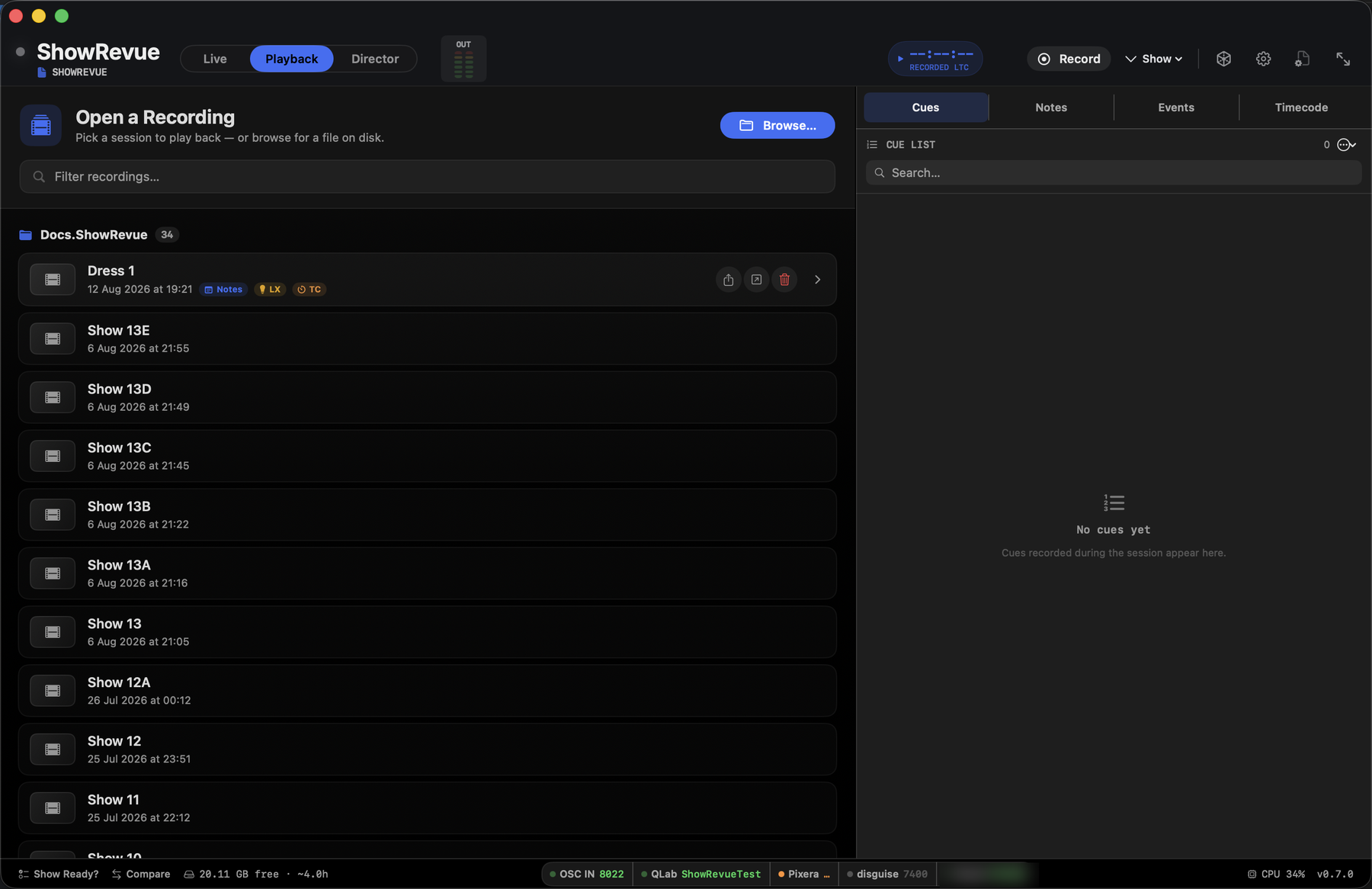
The Playback tab: pick a recorded session, then scrub the timeline and jump between cues.
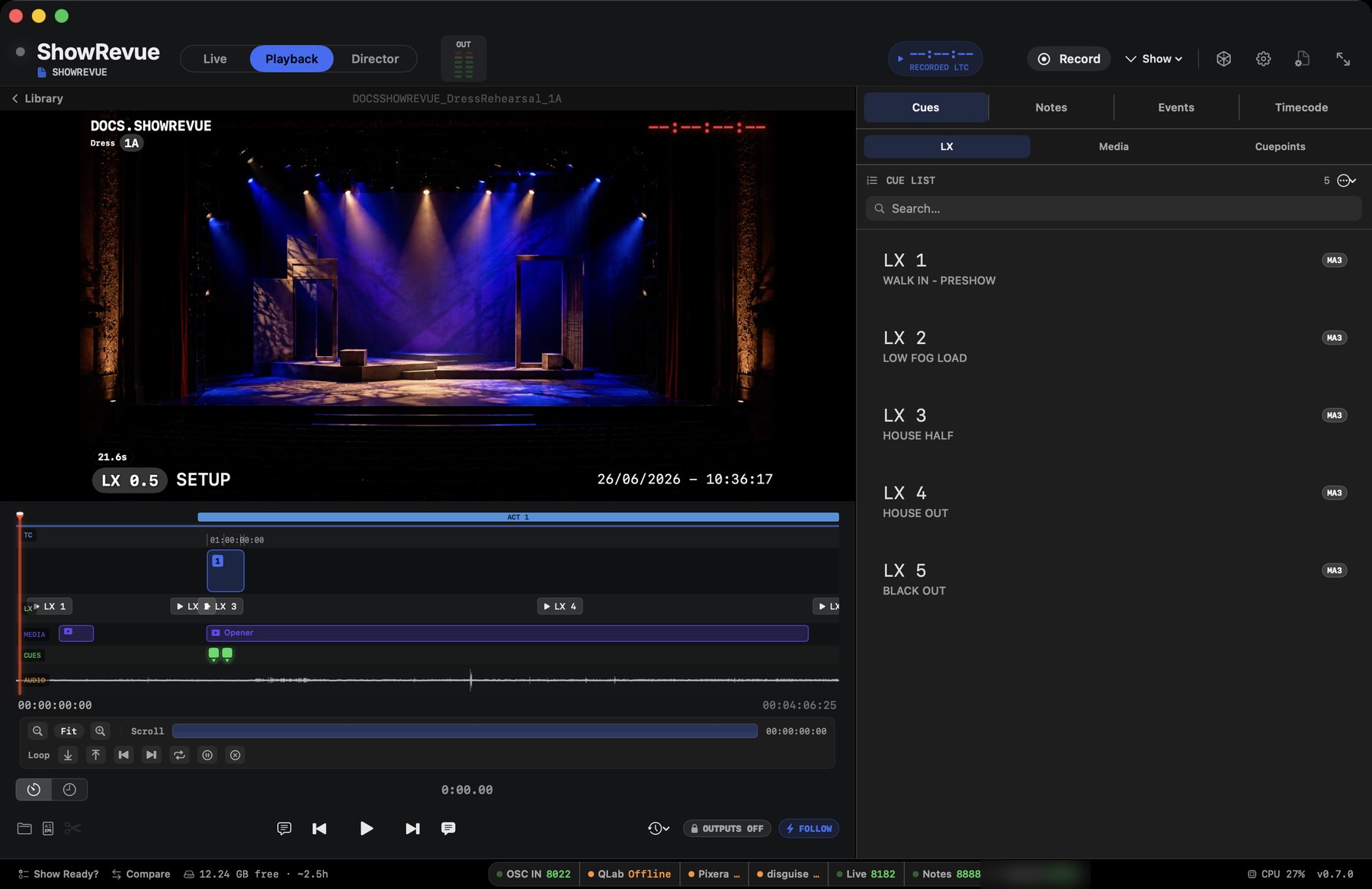
Playback: cue flags on the timeline and the cue list (LX 2 → LX 5), each tagged with its source console.
Scrubbing the timeline: the playhead moves through the recording past each cue marker.
Playback
- Click the Playback toggle in the toolbar centre.
- The most recent recording loads automatically.
- To load another file, drag it onto the player or click the folder icon.
The library's Timecode tab
Under the search field the picker has two modes. Recordings lists every take, newest first. Timecode turns the library inside out: sections first, and under each one every take that carries timecode inside it.
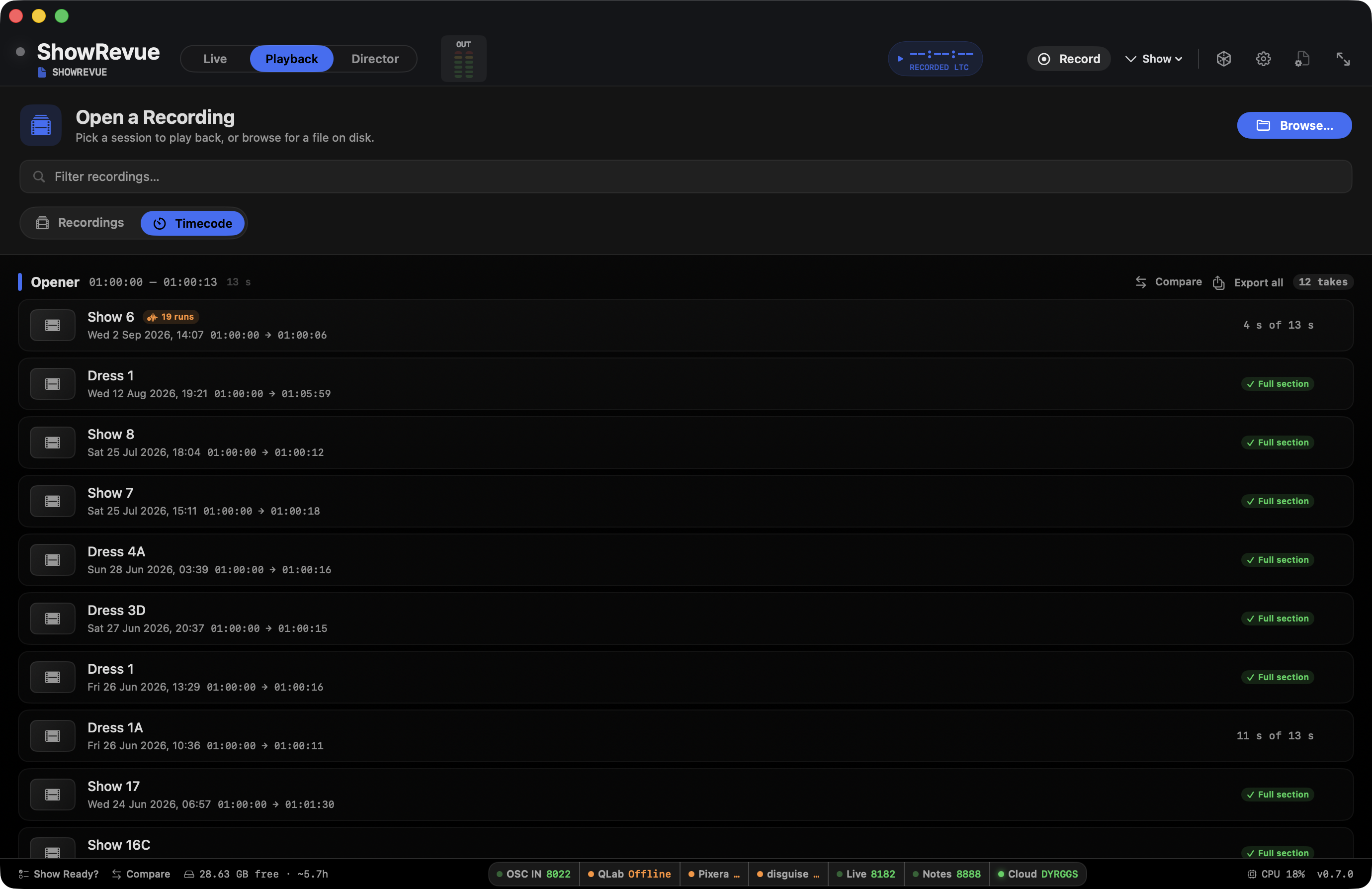
- Named sections come from the Timecode panel and show their LTC range. Runs of timecode with no name group by start timecode, within a minute of each other; double-click the header (or press Name…) to name one.
- Each take row shows the session, date, timecode in and out, and how much of the section it holds: Full section, or "4 s of 13 s". An orange runs pill means the timecode dropped out and came back that many times inside the section.
- Click a take to open it at the section's start. The arrow on the row exports that take's section as a clip, programme left and LTC right, with five seconds either side.
- Export all on the header writes one clip per take into a folder you pick. Compare opens the Compare sheet on the two newest takes.
- The search field filters this view too, by section name, take label or show name. A footer counts recordings with no timecode so they are not mistaken for missing.
Keyboard shortcuts
| Key | Action |
|---|---|
| Space | Play or pause |
| ← / → | Jump back or forward 5 seconds |
| < / > | Previous or next lighting cue |
| I / O | Set loop in or out point |
| M | Drop a named marker at the current position |
| C | Drop a cuepoint at the current position |
| ⌥[ / ⌥] | Previous or next cuepoint |
Transport keys are focus-scoped: Space and ← / → drive playback only while the video surface has focus. Click into a note or any text field and those keys go back to typing. A space is a space, and the arrows move the caret, not the playhead.
Markers
Press M during playback to drop a marker at the current position. You're prompted for a name (leave it blank for an auto "Marker 1", "Marker 2", …). Markers appear in the Events tab. Cuepoints do not; they are cues, and they live on the Cues tab. Tap one to jump to it, or right-click to rename or delete. Markers are saved with the recording, so they're there next time you open it.
Cuepoints
A cuepoint is your own callable show beat. A moment the show-caller runs off the app when there's no console data for it: a manual fly cue, a "cast GO", a standby. Cuepoints are separate from the recorded LX and OSC cues in the Cue list. Those come from the console; cuepoints are ones you place yourself.
They sit in their own Cuepoints lane on the Cues tab, beside LX, Audio, Media and Fly. The lane only appears once the show has at least one cuepoint.
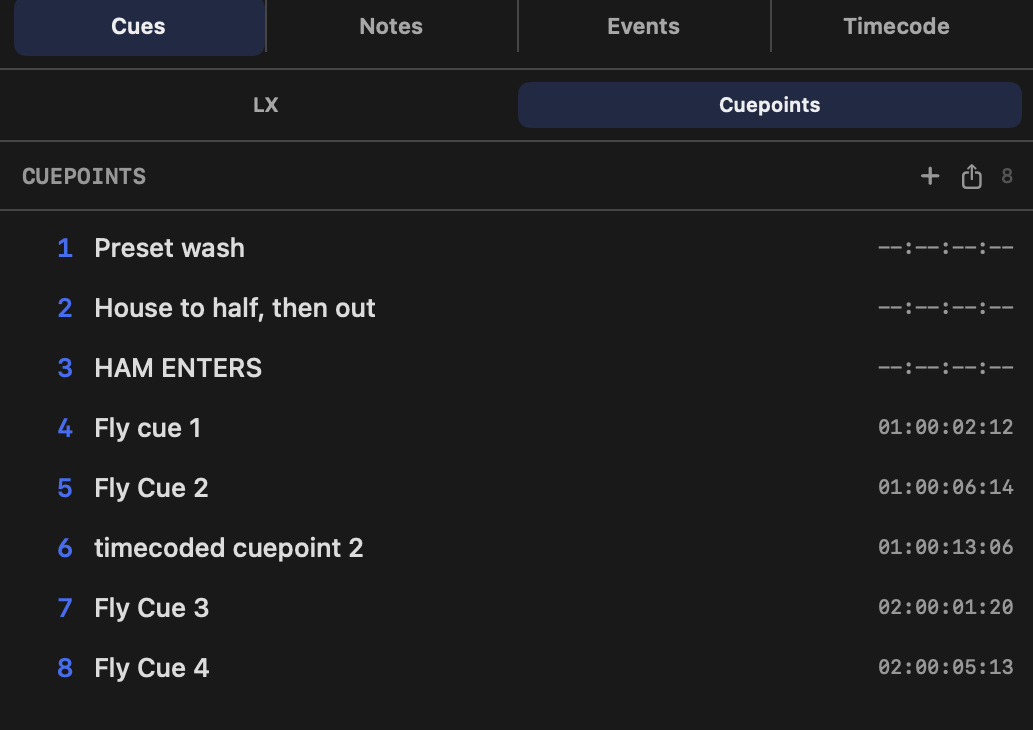
- Add one with the + button at the top of the Cuepoints lane, or press C. In playback you're prompted for a name and an optional fade; leave the name blank and it takes an auto "Cuepoint 1", "Cuepoint 2", …
- C works while recording too. In Live it drops the cuepoint straight away with no dialog, because stopping to type during a run is the one thing you cannot do. Name it later in playback.
- Cuepoints are numbered in the lane, in time order, and that is the order they export in.
- ⌥[ and ⌥] step to the previous and next cuepoint. Plain [ and ] walk every note, which is slow going on a rehearsal with fifty of them.
- Double-click a row to rename it in place, or right-click for Edit… and Delete.
- Cuepoints carry no department. A note is addressed to someone; a cuepoint is a position in the show where a cue should go, so there is nobody to address it to.
- Cuepoints auto-save to the recording's sidecar.
Fade
A cuepoint can carry a fade time in seconds, set when you add or edit it. It is the one field the recording cannot supply for you: a fade exists once the cue is programmed, and a cuepoint is dropped before that. Left blank, it exports as whatever default you choose at export time, so you can still drop marks fast and decide the fades later.
Anchor modes
A cuepoint anchors in one of two ways, depending on where it sits:
- Plain cuepoint. Placed outside any named timecode section, it pins to the recording's
run-time. It lives with that one recording.
Its timecode column reads
--:--:--:--, because it hasn't got one — it is a position in this file, not a position in the show. - Timecoded cuepoint. Placed inside a named timecode section, it chases the live LTC and becomes show-level: one set of beats across every recording of that show. Timecoded cuepoints also drive Director. They behave like cues there, feeding NOW / NEXT and the standby → GO countdown.
Creating a cuepoint in the player publishes it to the cloud straight away, no recording needs to be selected, because show-level cuepoints belong to the show, not to any single file.
Not in this recording
Because show-level cuepoints belong to the show rather than to one file, a take that only covers part of the show will not have a position for all of them. Those are listed separately under NOT IN THIS RECORDING, dimmed, and they don't seek. They are not lost — open a take that does cover that timecode and they sit in the list normally.
Export a cue list for the desk
The export button at the top of the Cuepoints lane opens a sheet. Pick a format, set the numbering, press Export… and choose where the file goes.
| Format | What it writes |
|---|---|
| Spreadsheet | One CSV to read and mark up: cue, label, fade, timecode. Nothing goes to a desk. |
| grandMA2 | A macro XML. Import it on the desk and run it; it stores one empty, labelled cue per cuepoint into the sequence you name. |
| grandMA3 | The same, as an MA3 macro. |
| ETC Eos | An ASCII showfile. File ▸ Import ▸ ASCII Show File on the desk puts the cues in the list you name. |
| CuePoints | One timecoded CSV per recorded timecode section, for the CuePoints app. |
The fields change with the format:
| Field | Shown for | What it does |
|---|---|---|
| Sequence / Cue list | grandMA, Eos | Where the cues go on the desk. Anything already in it is overwritten, so pick one you know is free. |
| First cue | all | The number given to the earliest cuepoint |
| Step | all | How much each following cue number increases by |
| Fade | Spreadsheet, CuePoints | Used for any cuepoint that has no fade of its own |
The desk exports carry no timecode, on purpose. They put a numbered, named, empty cue list on the desk for the programmer to record into; timing it is a separate job. The recorded cues match up by cue number afterwards as they always did.
The spreadsheet's Timecode column is the real LTC timecode, so the cue lands where the show is, not where the video file happens to start. A cuepoint whose timecode was not recorded in this take exports with that column blank.
CuePoints imports a spreadsheet onto one track, and a track runs one stretch of timecode, so a show recorded as three timecode runs gets three files. The name you choose is the stem; each file adds its section's start timecode. Columns are Timecode, Cue Name, Cue ID and Fade, which is what CuePoints asks you to match under File ▸ Import CuePoints From File ▸ To Current Track Comma Separated…. Set the track's timecode offset to the section's start first. Cue IDs are numbered across the whole show, so no two tracks share a number, and a cuepoint whose timecode was not recorded in the take is left out.
Cue list
The Cues panel lists every cue recorded. Click a row to jump frame-accurately to that moment.
- Click the cannon icon to fire the cue on the connected console. This requires the Capture licence tier or above.
- Filter by source: All, LX, or Media.
- Export CSV from the export icon at the top of the panel.
Media cue export
The Media lane exports a cue list with the file behind each cue, not just its number:
Cue,Label,Source,Timecode,Start,Duration,End
12,Act 1 playoff,playoff_v3.wav,01:12:04:08,0:00:00.0,0:01:34.2,0:01:34.2
Start, Duration and End are positions within the media file; Timecode is where the cue fired in the show. That's the difference between "this file is 94 seconds long" and "this 94 seconds happens here", and a cue sheet needs both.
If your desk runs parallel sequences (followspots, house lights, effects), the highlight and auto-scroll follow your main sequence rather than whichever list fired last. ShowRevue treats the busiest sequence as main, or you can nominate one in Project Settings. "LX cue went backwards" warnings also compare within a single sequence, so a followspot list restarting at cue 1 no longer raises them.
Cue tracking
ShowRevue listens for OSC messages from your console on the OSC In port, which defaults to 8000.
When a cue fires on the console, ShowRevue:
- records the cue number and any label supplied by the source system alongside the video frame,
- logs the cue in the Cues panel with a timestamp,
- updates the live overlay.
The OSC In chip in the toolbar shows a green dot when the listener is active. If it is red, check Preferences → Lighting Consoles and confirm the port is not blocked by the macOS firewall.
Loop mode
Loop mode is useful for rehearsing a repeated section of video.
- During playback, navigate to your start point.
- Press I or click Set In.
- Navigate to your end point.
- Press O or click Set Out.
- Press L or click Loop to enable looping.
ShowRevue will play between the in and out points continuously until loop mode is turned off.
Follow mode
Follow mode sends recorded cues back to connected lighting and media systems during playback.
- Load the recording you want to rehearse from.
- Confirm your console and media server connections are live.
- Click FOLLOW in playback.
- Start playback.
With Follow mode enabled, ShowRevue fires cues back to supported devices as the recording reaches each cue point. Treat it as a live show-control output and only enable it when the stage systems are ready.
It matches the show's state when you enable it
Turning Follow mode on sends immediately — it does not wait for playback to reach the next cue. Otherwise the rig would sit wherever it happened to be while the recording played something else entirely, which could last minutes.
The same happens after you seek. Jump to another point in the recording and the rig follows you there.
What it sends is the most recent cue at or before the playhead, once per lane: one per Eos cue list or MA sequence, and one per media source. It never replays the cues in between, so starting an hour into a show sends a handful of commands rather than hundreds. Lighting fireback is a GOTO, so the console jumps straight to that cue.
A followspot list is restored alongside the main list rather than being shadowed by it, and QLab and Millumin don't displace each other.
Because enabling Follow mode fires straight away, press it only when the stage is ready — not while parking the playhead to set up. Outputs still have to be armed first, and every safety gate applies. If something blocks the send, ShowRevue says which gate stopped it rather than reporting success.
disguise is the exception. Its sections are named rather than addressable over OSC, so there is no way to jump to one. ShowRevue says so instead of sending a transport command that would start from the wrong place.
The live cue list (Live mode)
You don't have to be in playback to see the cue list. While recording, a cue list slides in from the right of the Live view. Tap the CUES tab on the right edge to open it.
- It splits into the same lanes as playback, LX / Audio / Media / Fly, plus a Notes tab, and follows cues and notes as they land.
- It only ever shows the current live session's cues, never a loaded recording's.
- Tap a cue or note and ShowRevue launches Time Warp, its live DVR scrub, and jumps to that moment in the take, so you can check what just happened without stopping the recording.
Time Warp arms about 15 seconds into a take and needs the Production tier. Tap the TIMEWARP button in the toolbar again to return to live.
Enable online training
Playback → Enable Online Training… prepares a recording for the online show-calling trainer at
showrevue.com/trainer. It needs a signed-in Production (or higher) account. ShowRevue mints a
signed entitlement token, embeds it in the recording, and writes the show's acts so the trainer can
offer act picks. It works on old recordings too. A recording without the token is blocked at the
trainer. See Show-Calling Trainer.
Recover timecode from audio
Playback → Recover Timecode from Audio… is for takes where LTC was recorded on an audio track but never decoded live. ShowRevue decodes the LTC track offline and writes timecode blocks and per-cue LTC back into the recording, so the take gains the timecode it should have had.