Stage Display
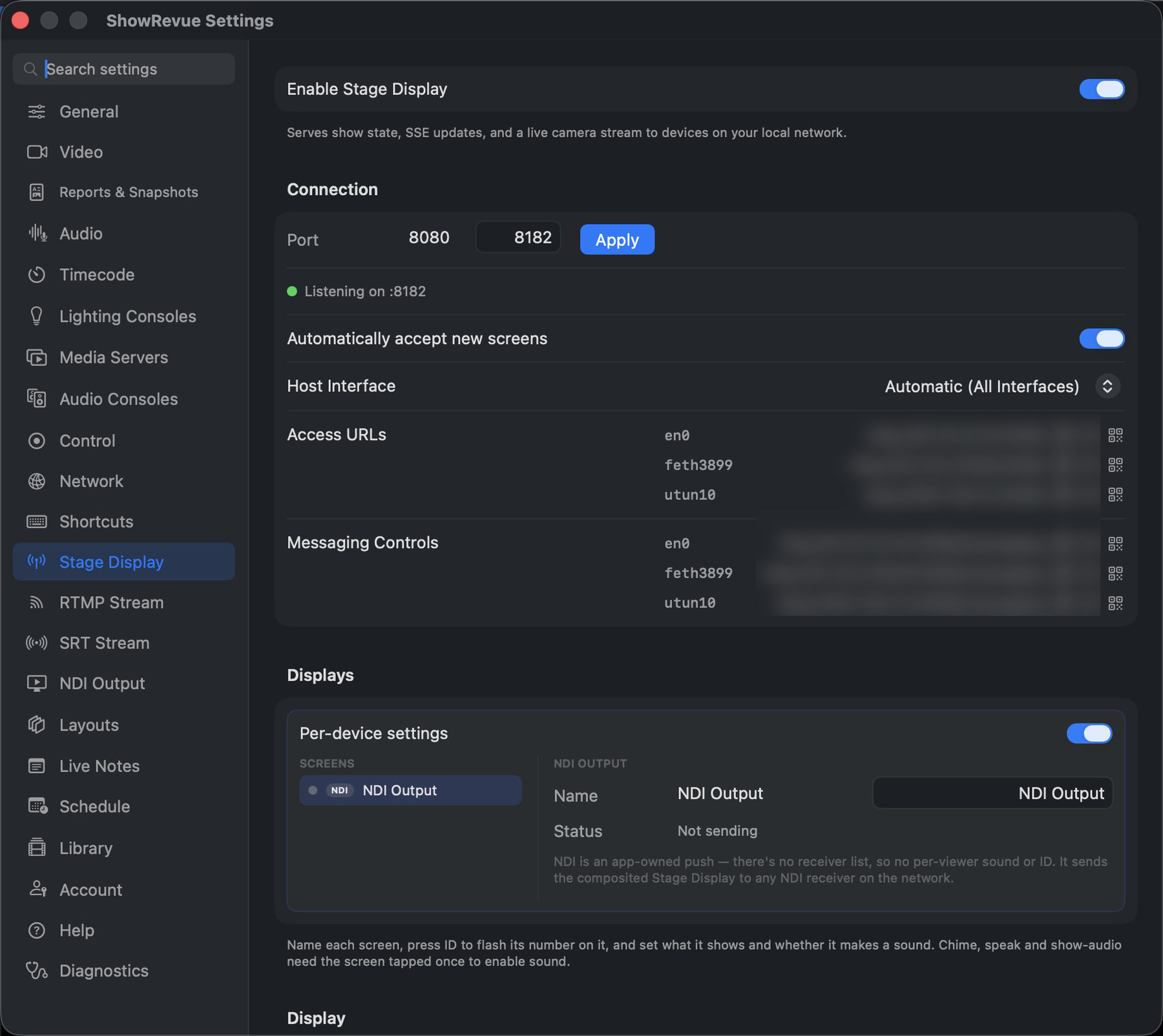
Preferences → Stage Display: port, host interface, the connected-screens list, and per-screen settings.
Stage Display serves a local-network web page showing live show state. Any device with a browser can connect. No separate app is required.
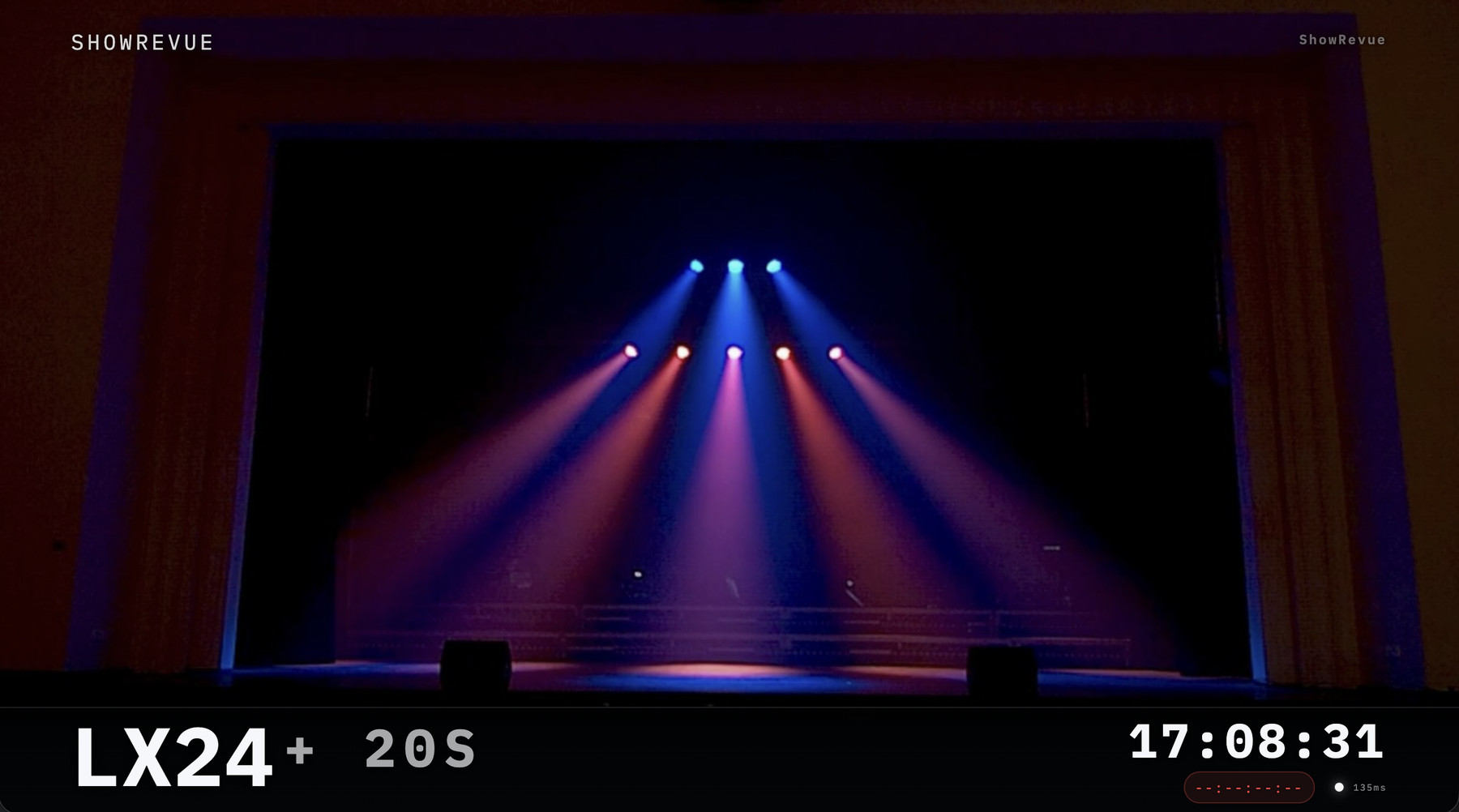
The Stage Display web page: live camera feed, cue state, and show clock.
Requires the Production licence tier or above.
Enabling Stage Display
- Open Preferences → Stage Display.
- Turn Enable Stage Display on.
- Use the Copy URL icon to copy the address shown there, for example
http://192.168.1.10:8080. - Use the QR code icon if you want phones or tablets to join quickly.
- Open that URL on any device on the same Wi-Fi or wired network.
Putting it on a screen
Stage Display is just a web page, so you can drive a screen any way you like:
- Straight off the Mac (HDMI). Plug a monitor into the Mac and toggle Stage Display onto it with ⇧⌘D (or pick the display in Preferences → Stage Display). It always opens on an extended display. It never takes over your main operating screen. If no second display is attached, the shortcut does nothing.
- Any browser. Open the URL on a phone, tablet, dressing-room monitor, or foyer screen.
- Digital-signage players. Point a signage player at the URL. BrightSign, ScreenCloud, Yodeck, OptiSigns, a Raspberry Pi, Apple TV, or a Samsung/LG smart display all work.
Approving screens
Instead of a PIN, Stage Display uses an approval model.
- Automatically accept new screens (default on): any device that opens the link goes live straight away.
- Turn it off and a new screen shows a waiting for approval page and appears in the Displays list as Pending. Select its row and Approve (it goes live instantly) or Block (it's refused).
Approval binds to the screen, so it survives a reconnect or a relaunch. A blocked screen shows a screen blocked page and returns to the show on its own once you Unblock it (blocked screens are listed under the Displays panel). A directly-connected monitor is always trusted.
Per-device settings
Every connected screen appears in the Displays list in Preferences, so you can tell them apart and set each one differently.
- Name each screen ("Green Room", "SM Desk").
- ID flashes the screen's number on the physical monitor so you can see which is which.
- Shows picks the screen's content mode (below).
- Sound sets its alert behaviour (see Sound).
- Show audio relays the programme audio to that screen.
- This screen's look (Full mode only) overrides the top-left content, logo, and which readouts show — per screen. The global Display section is the defaults new screens inherit.
Identity is remembered in the browser, so a screen keeps its name and settings across reconnects and reloads.
Content modes
Set each screen's Shows to match its job:
| Mode | Shows | Good for |
|---|---|---|
| Full | Camera + cue state + messages | Booth-side monitors |
| Camera only | Clean camera feed, no overlay | Director monitor, archive tap |
| Green room | Camera + show state + messages | The watch-and-listen room |
| Messages only | Operator messages + show state, no camera | Dressing rooms |
| Cue only | Big current lighting cue, no camera | DSM repeater, low-bandwidth screens |
| Clock | Big wall clock | Pit, band, wings |
| Countdown / calls | Show state + curtain countdown | Foyer, bars, corridors |
Camera-less modes don't pull the video stream, so they're light on bandwidth. A Stage Hold / evacuation alert overrides every mode.
When a camera mode has no picture yet (the feed is still spinning up, or the source has dropped), the screen shows analogue-TV static behind the overlay rather than a black rectangle, so the readouts stay legible.
What the Full view shows
| Element | Source |
|---|---|
| Show name or venue logo | Project Settings, or a per-screen logo |
| Current lighting cue | Console OSC |
| Elapsed time since last cue | Auto-calculated |
| Current media cue | QLab OSC |
| Wall clock | Mac system time |
| LTC timecode | Audio LTC input |
| REC status | Recording state |
| Live camera feed | MJPEG stream |
| Show State — Preshow / Act / Interval / Total | Lighting cues + project timing |
Display options
The Display section sets the defaults for new screens; override any of them per screen under This screen's look:
- title mode — show name, custom text, or logo. The logo can be the Show Logo from Project Settings or a custom PNG. A logo can also be chosen per screen,
- visibility for cue number, cue name, LTC, media cue, recording state, elapsed time, and the Show State pill,
- Hide branding (removes the ShowRevue wordmark) — top tier only.
Sound
Each screen has a Sound profile: Silent, Chime, or Chime + speak (a spoken read-out of the message).
- A browser needs one tap ("tap to enable sound") before it can play audio — a browser autoplay rule. The speaker icon in the Displays list is amber until a screen is tapped, green once it's armed.
- A directly-connected monitor enables sound on its own — no tap. For unattended browser signage, either tap once during setup or launch the kiosk browser with its autoplay flag.
Show audio relay
Turn on Show audio for a screen to relay the programme audio to it — a backstage monitor / tannoy feed. It's roughly half a second behind and is not lip-synced to the picture; treat it as "hear where the show is". Set the per-screen volume; alerts automatically duck the show audio under them and ease it back. The Displays list shows each screen's measured latency.
- Relay works on browser screens. For a direct HDMI monitor, route the display's audio out its HDMI under Preferences → Audio → Outputs instead — the web relay can't target a specific HDMI output.
- NDI carries its own audio in the stream (see NDI Output).
Mask
Use Mask On or the OSC command /showrevue/mask/on to cover the output with a BLOCKED screen. Use Mask Off or /showrevue/mask/off to restore the live view.
Live messages
Stage Display can display full-screen operator messages:
- from the message controls inside ShowRevue,
- or through OSC,
- including preset calls such as house open, places, interval, and hold states, and a continuous Stage Hold / evacuation alert.
Messaging page
The /messaging URL on the same host opens a dedicated operator control panel. Preset stage management calls, output mask, custom messages, and manual show state control. See Stage Display Messaging for full details.
Network notes
- Stage Display uses plain HTTP.
- If other devices cannot connect, confirm macOS allows incoming connections on the configured Stage Display port.
- The MJPEG stream endpoint is
/stream.mjpeg. The main page loads it automatically.