Project Settings
Project Settings hold everything that is specific to this show and travels with the
.srshow project file, so when you move the file to another Mac, or a team member opens it, the
show's identity, cue mappings, timing, and note colours come with it.
Open it from File → Project Settings… (⌘⌥,).
Project Settings (⌘⌥,) are saved in the show file and travel with it.
Preferences (⌘,) are machine-level. Console IP addresses, audio devices, output folders, and
the like stay on the Mac you set them on.
Show
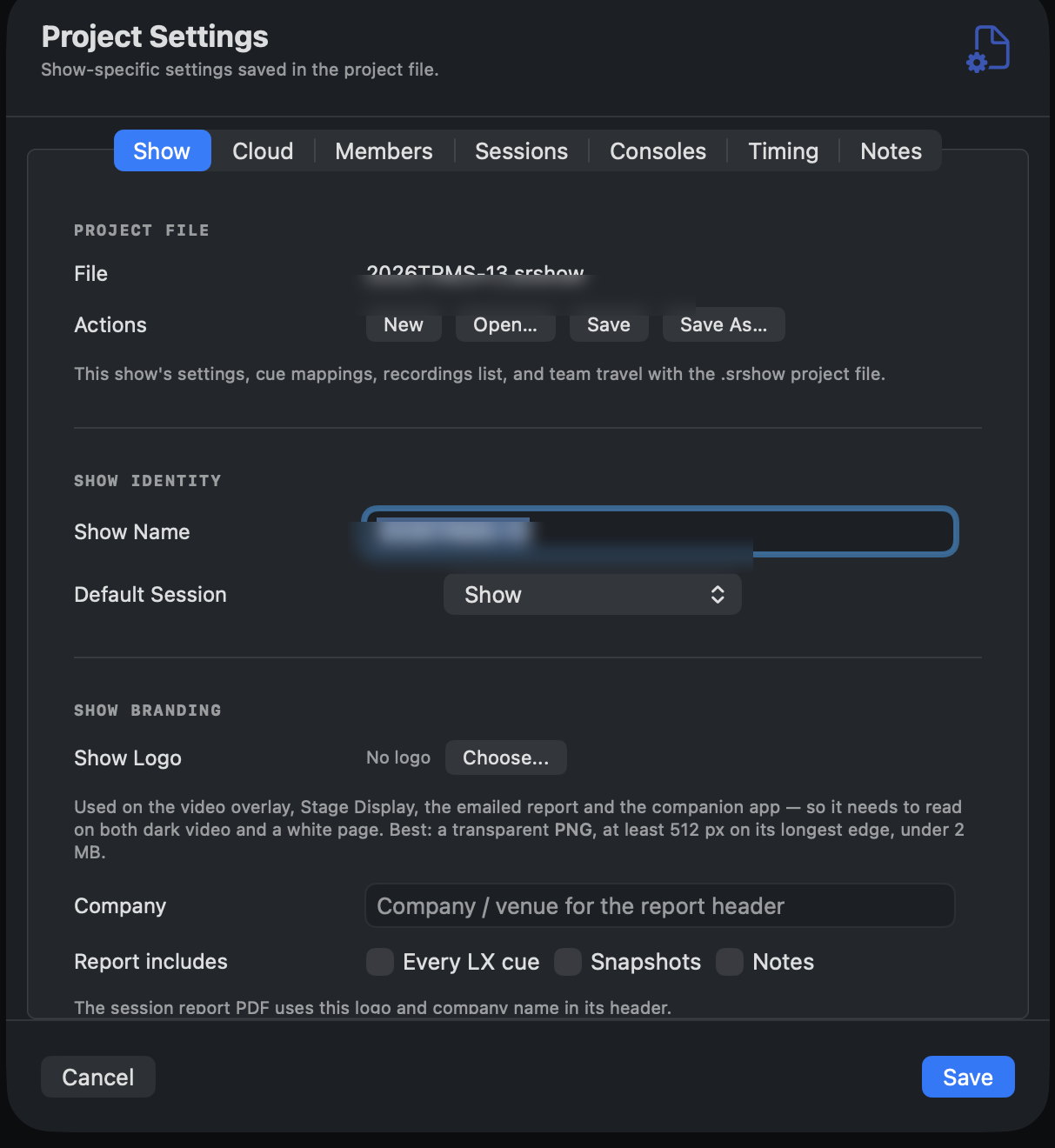
The home tab.
- Project file.
New,Open…,Save,Save As….Newopens the Launch New Show wizard, the single way to create a project (a Skip button gives you the quick path). The show's settings, cue mappings, recordings list, and team travel with the.srshowfile. - Show identity. The Show Name and the Default Session type used for new recordings.
- Show branding. An optional Show Logo (PNG/JPEG, transparent or dark-friendly), shown on the Stage Display when present. You can set it in the Launch New Show wizard or change it here.
- Overlay layouts. Jump to the recording overlay editor (Show State, cue display, clock, logo placement). The widget layout is saved with the project.
Cloud
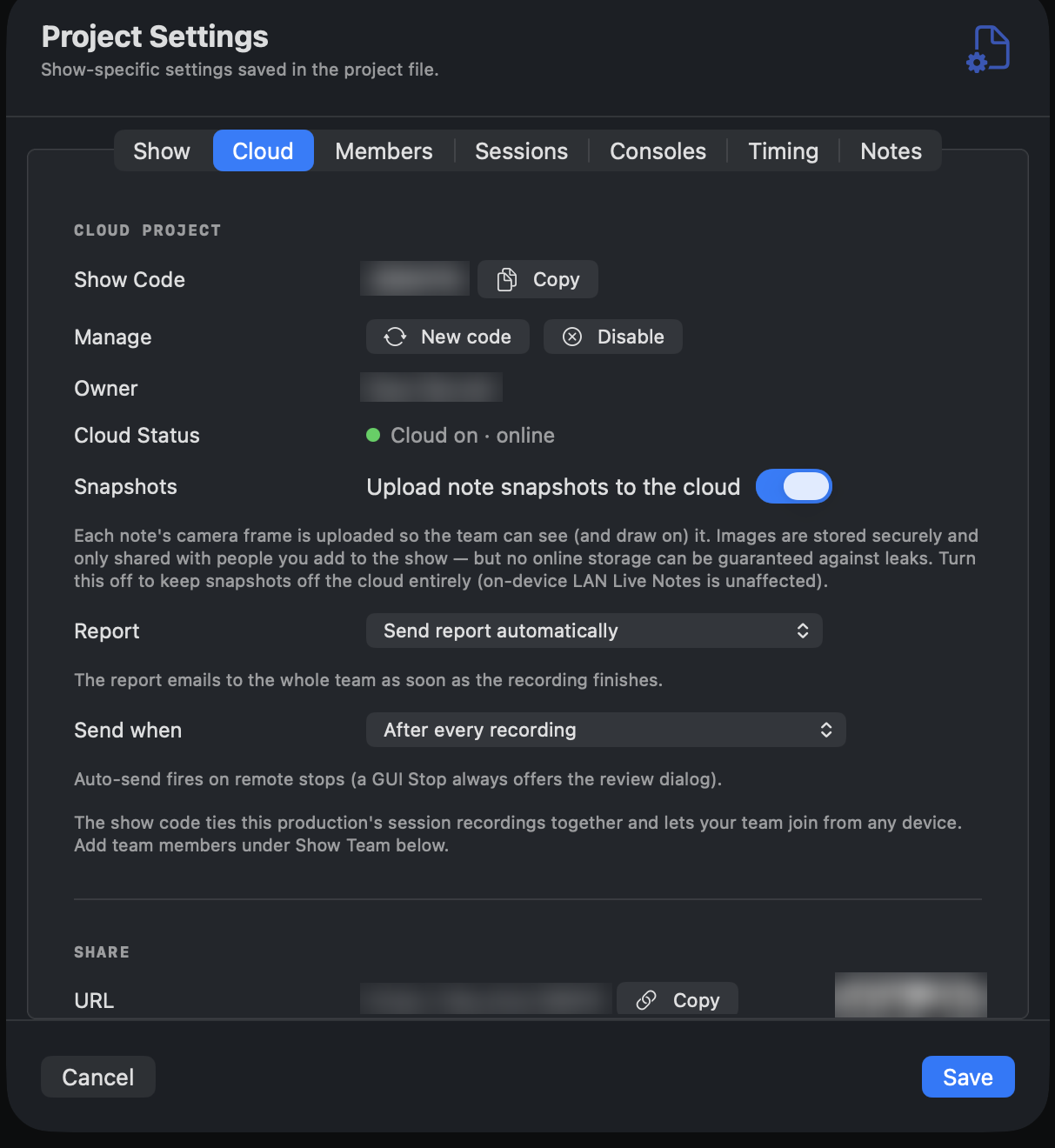
Ties this production's recordings together and lets the team join from any device.
- Show Code. The join code for the show. Use
New codeto roll it, orDisableto turn cloud off. Team members join with this code (or the share URL / QR at the bottom). - Owner and Cloud Status. Who owns the cloud show and whether it's online.
- Snapshots. Optionally upload note snapshots to the cloud. With it off, images stay on local storage and on-device LAN Live Notes is unaffected.
Each note's camera frame is uploaded to the team per cue; images are stored securely and only shared with people you add to the show. Add team members under the Show team roster. Access is granted by the roster, there's no shared password.
- Report. What happens to the session report when a recording finishes: Send report automatically, Store a draft report in the cloud, or Store a draft and notify the stage manager. This mirrors to the website, so the show's page agrees. When it's set to send automatically, a Send when picker chooses the trigger, after every recording, once per day (the day's last recording), or only a completed show that reaches its end cue. Auto-send fires on a remote stop; a GUI Stop always offers the review dialog. See Reports.
Backup host
Two Macs can't clobber one cloud show. The active host claims a single-writer lease on every push; if a second Mac tries to publish to the same show it's rejected and stands down, so a stray open of the same production never fights the desk for control.
To run a hot spare, tick Run this Mac as a backup host. The backup captures the show locally like any other Mac but doesn't publish to the cloud while the primary host's lease is healthy. If the primary's lease goes stale (it drops off the network or crashes) the backup takes over automatically, once it's receiving timecode and cues of its own, and starts publishing in the primary's place.
Prompt Copy
The show owner nominates one recording as the show's Prompt Copy. The take the cloud Director runs off by default when someone opens the show with no file or video of their own.
Sessions
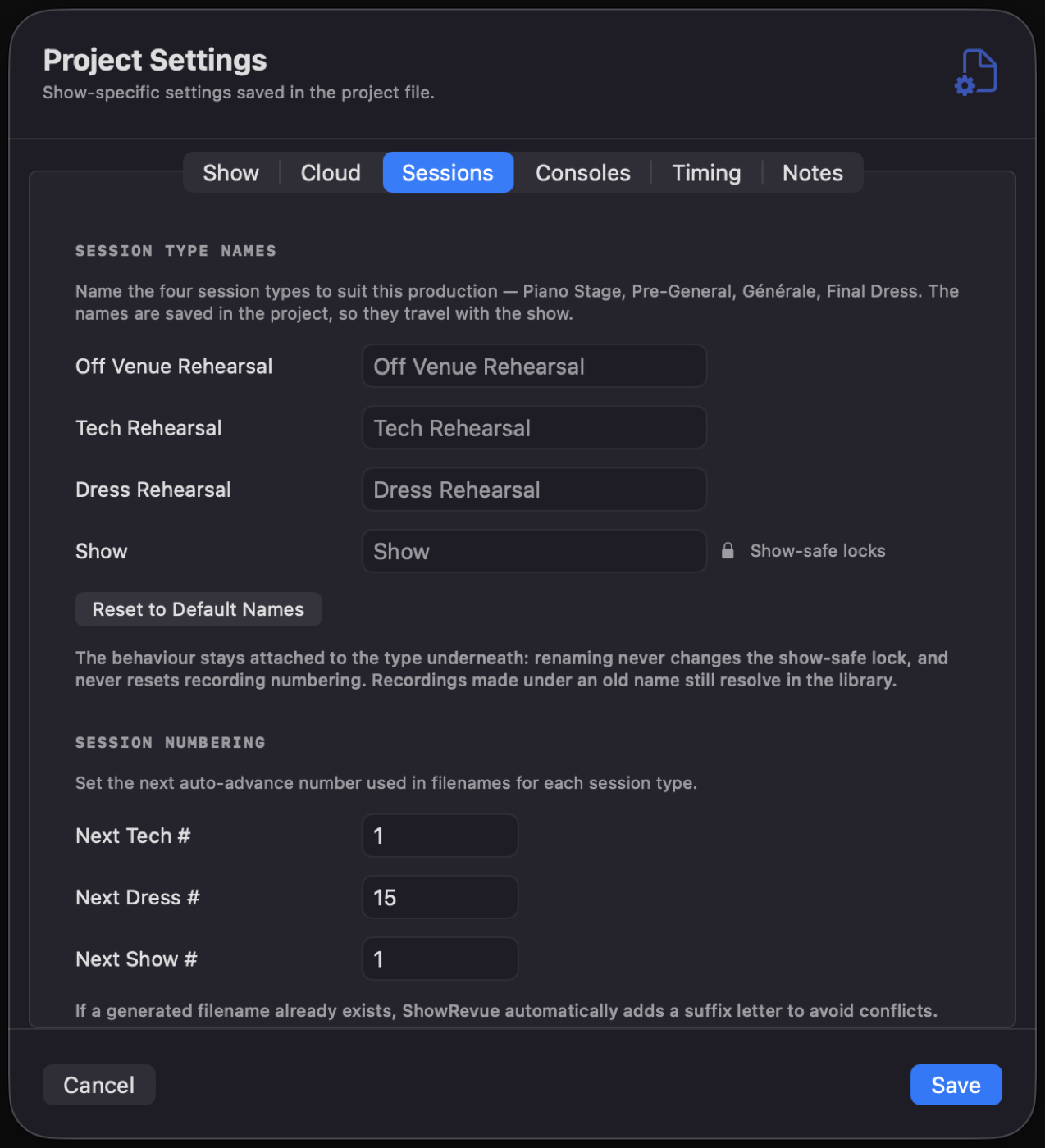
Session numbering. The next auto-advance number used in filenames for each session type (Tech, Dress, Show). If a generated filename already exists, ShowRevue automatically adds a suffix letter to avoid conflicts.
Session type names. Rename all four types to whatever your house calls them: Piano Stage, Pre-General, Générale, Final Dress, in any language. The names are saved in
the .srshow and travel with the production, so two shows on one rig can name their types
differently.
The names are labels only. The type identity underneath is unchanged. The fourth type still drives the show-safe output lock and the date-stamped show filenames whatever you call it, renaming never resets your numbering, and recordings made under an old name still resolve in the library.
Consoles
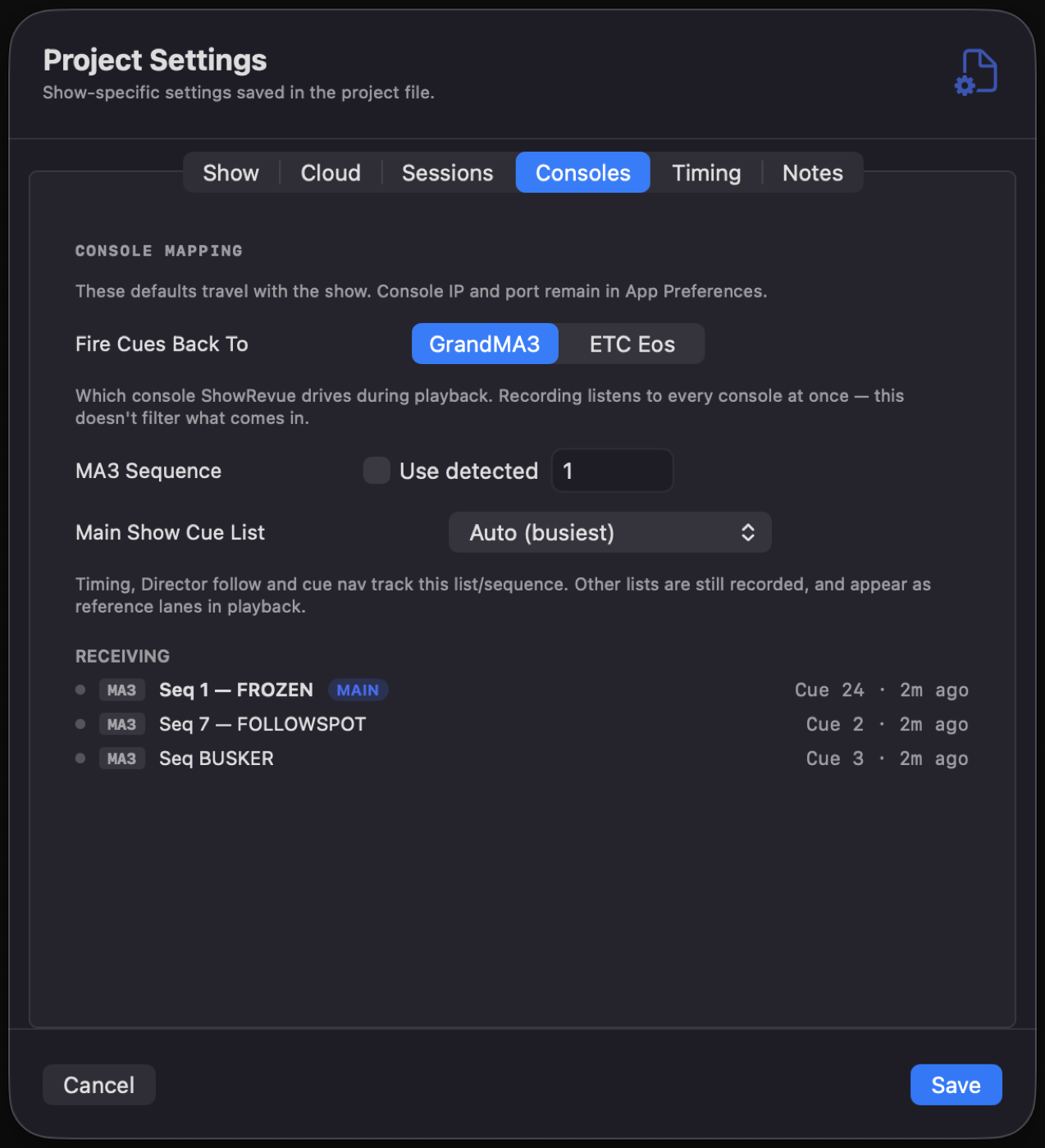
The main show cue list picker, and the Receiving panel showing every list the desk is running.
Fire Cues Back To. Which console playback fires cues back to (grandMA3 / ETC Eos; grandMA2 is receive-only). The console's IP address and port stay in App Preferences (machine-level), since they change per venue.
Main show cue list
Shows often run several cue lists at once. The book, followspots, video-from-LX. Every list is recorded, always. But one of them is the show, and ShowRevue needs to know which: the main list drives running-time and interval timing, Director NOW/NEXT follow, up/down cue navigation, the Main Lighting Cue overlay widget, Stage Display and Live Notes.
Main Show Cue List lists every Eos cue list / MA sequence this show has ever been heard running. By number and by the console's own name for it ("List 5 (FOLLOWSPOTS", "Seq 2) FROZEN"). The roster is saved in the project, so it's populated the moment the show opens, before you record a frame. The other lists stay as reference lanes in playback, and can be put on the layout with Secondary Lighting Cue widgets.
Receiving
Under the picker, Receiving shows each list the desk is currently running, with its console badge, its last cue number, and how long ago that cue fired, so you can see at a glance that the followspot list hasn't gone quiet. It's live-only: a reopened show never shows a stale "12m ago" from last week.
Timing
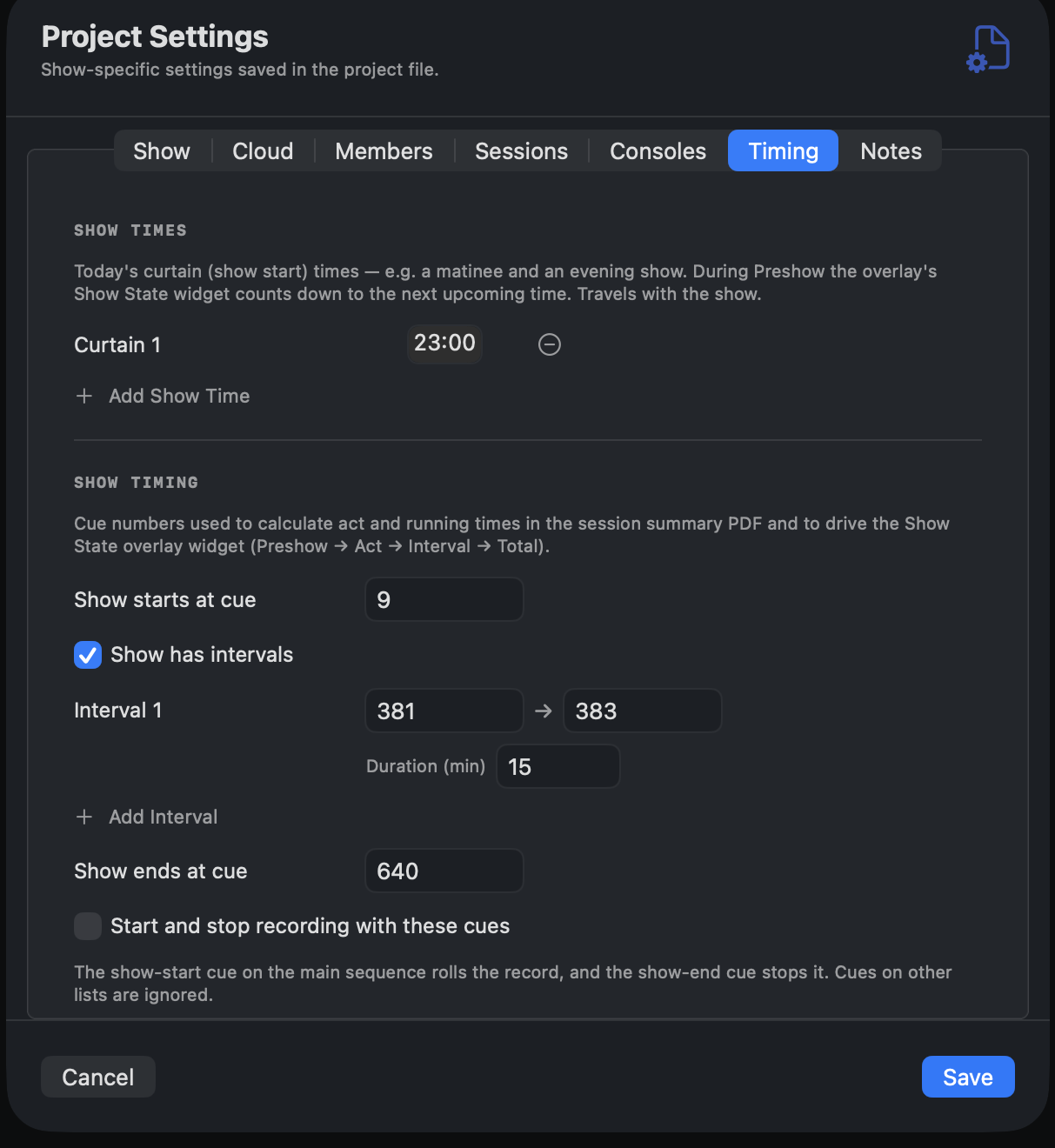
Drives the running times in the session summary PDF and the Show State overlay widget. The acts, interval lengths and curtain times are first set in the Launch New Show wizard when you create the project; this tab is where you edit them afterwards.
- Show times. Today's curtain (show-start) times, e.g. a matinee and an evening show. Times count down to the next upcoming one and travel with the show.
- Show timing. The start, interval, and end cues used to calculate act and running times (Preshow → Act + Interval + Total). Turn on Start and stop recording with these cues and the same two numbers drive the transport: the show-start cue on the main sequence rolls the record, the show-end cue stops it. Cues on other lists are ignored.
- Show State widget. Auto-advance Show State from lighting cues, and optionally hide the widget unless the session is a Dress Rehearsal or Show (so the countdown isn't misleading in tech).
Notes
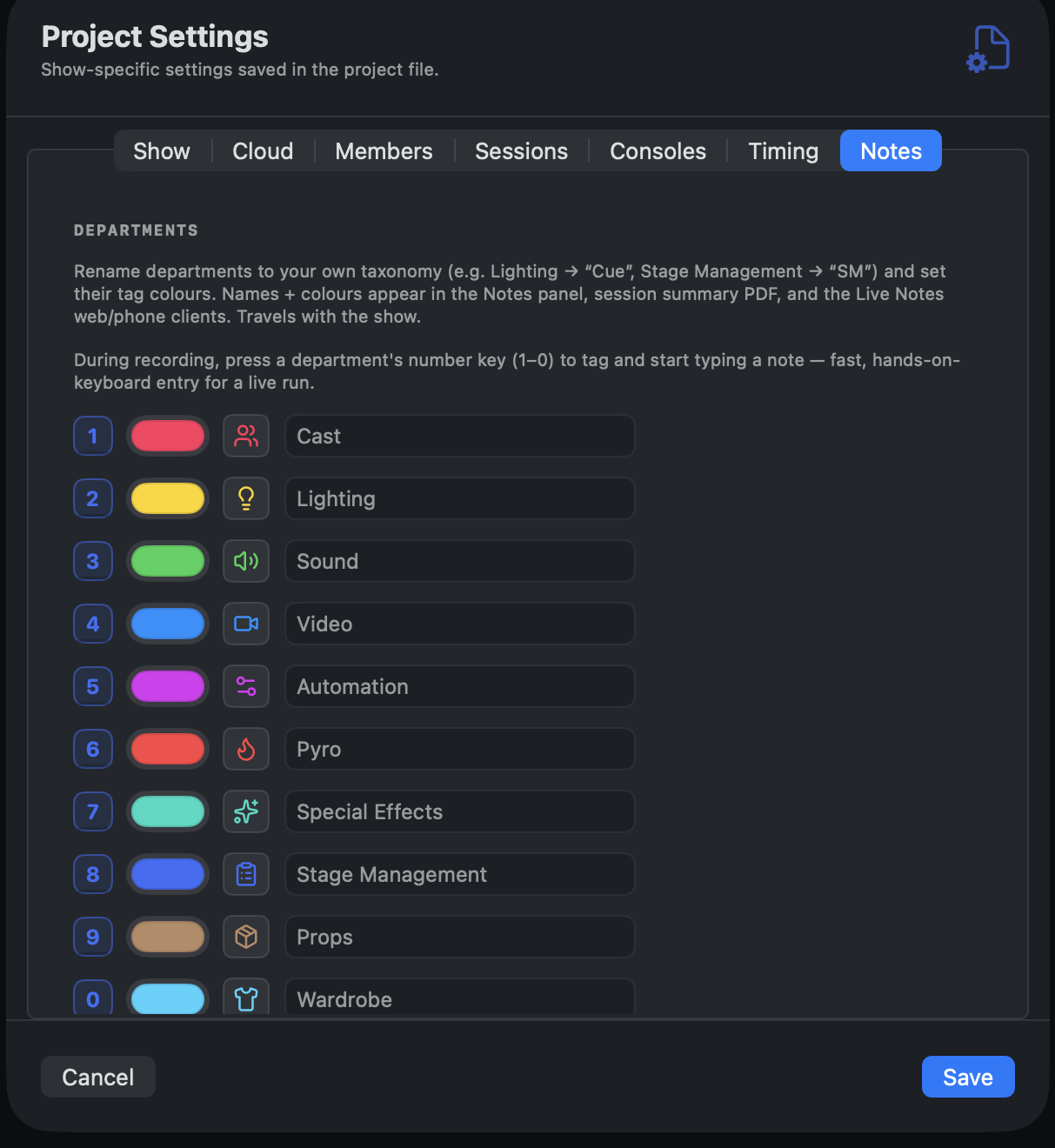
Department colours used for note department tags in the Notes panel, the session summary PDF, and the Live Notes web client. Cast, Lighting, Sound, Video, Automation, Pyro, Special Effects, Stage Management, Props, Wardrobe, and Scenic. These travel with the show.