Show Calling Trainer
The Show Calling Trainer ("Call the Show") is a cue-calling drill for the DSM. Open a recorded take, then standby and Go every cue as it comes (by keyboard or by voice) and get scored on how close each call lands to the recorded cue, to the tenth of a second.
It runs on its own player, completely independent of the live take and the main playback timeline, so you can practise without touching the recording.
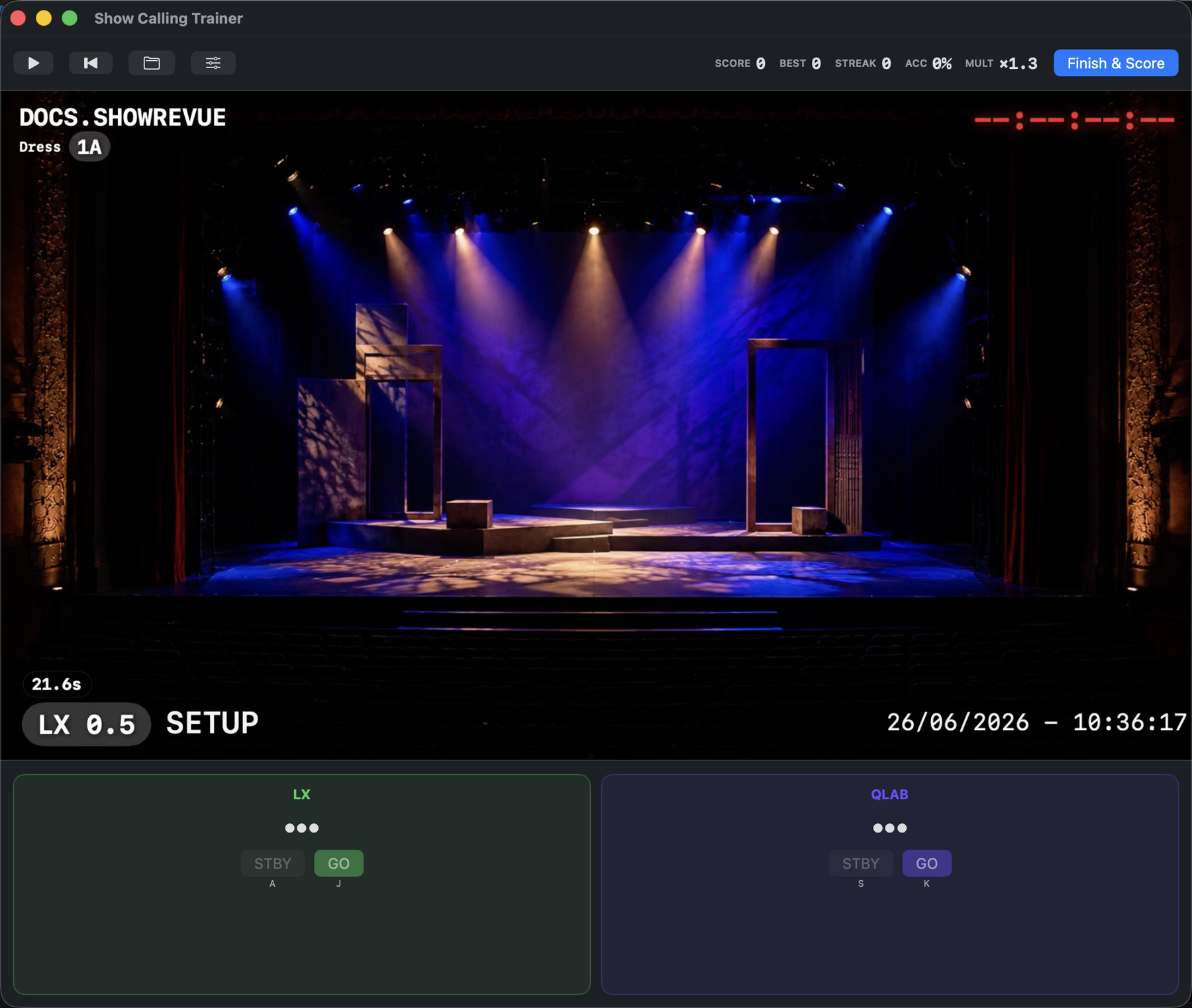
Transport and live Score / Best / Streak / Accuracy up top, the take playing with its overlay, and the next LX and Media cues as standby/Go cards. Hit Go as each lands.
Opening a session
Open the trainer from the window menu → Show Calling Trainer, then Open a recording with cues. The trainer reads that file's own cues. It doesn't touch the project's live cue list.
Input is disabled until playback is running, so you call in real time against the moving take.
Calling cues
Cues are organised into three columns by type (LX, Media, and Fly) each with a Standby and a Go.
Keyboard
| LX | Media | Fly | |
|---|---|---|---|
| Standby | A | S | D |
| Go | J | K | L |
Standby the next cue in a column, then Go it when the moment lands.
Voice
With voice calling enabled, call cues out loud ("Standby LX 47", "LX 47 Go") and the trainer recognises the type and number. A bare "Go" fires the armed column, and stays armed for rapid back-to-back Gos. Recognition is on-device.
Voice calling requires macOS Dictation to be enabled (System Settings → Keyboard → Dictation) and microphone permission. You can pick a dedicated input device so the mic doesn't clash with the program audio.
Scoring
Every call is scored against the recorded cue time, to the tenth of a second, and graded. The scorecard shows your accuracy and the off-by delta for each cue; a history keeps past sessions.
Difficulty multipliers raise the challenge:
- Hide video. Call blind to the timeline.
- Hide hints. No on-screen standby prompts.
- Voice. Call out loud instead of by key.
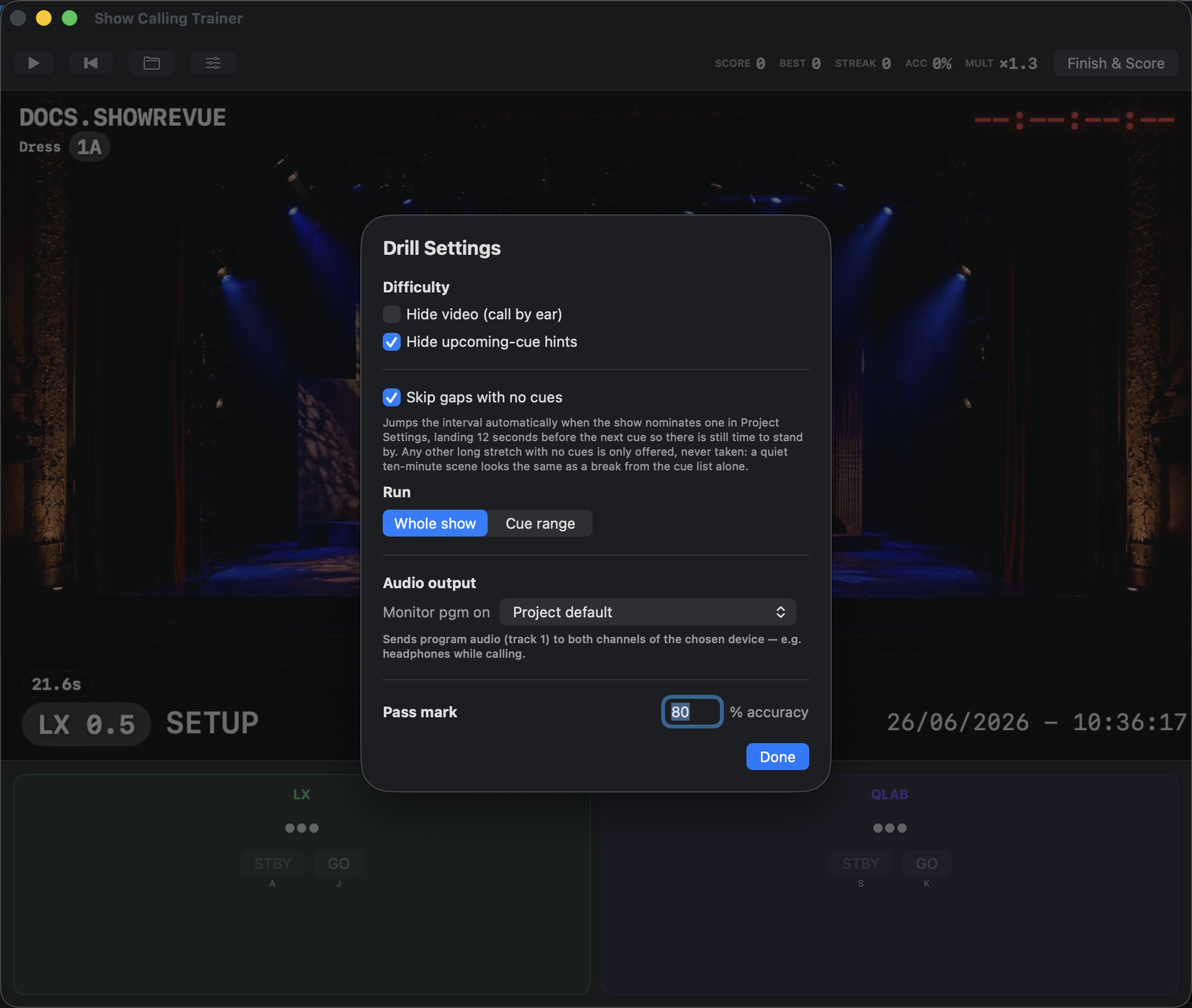
Drill Settings: the difficulty toggles, Whole show / Cue range, the monitor-audio output, and the pass mark (% accuracy needed to pass).
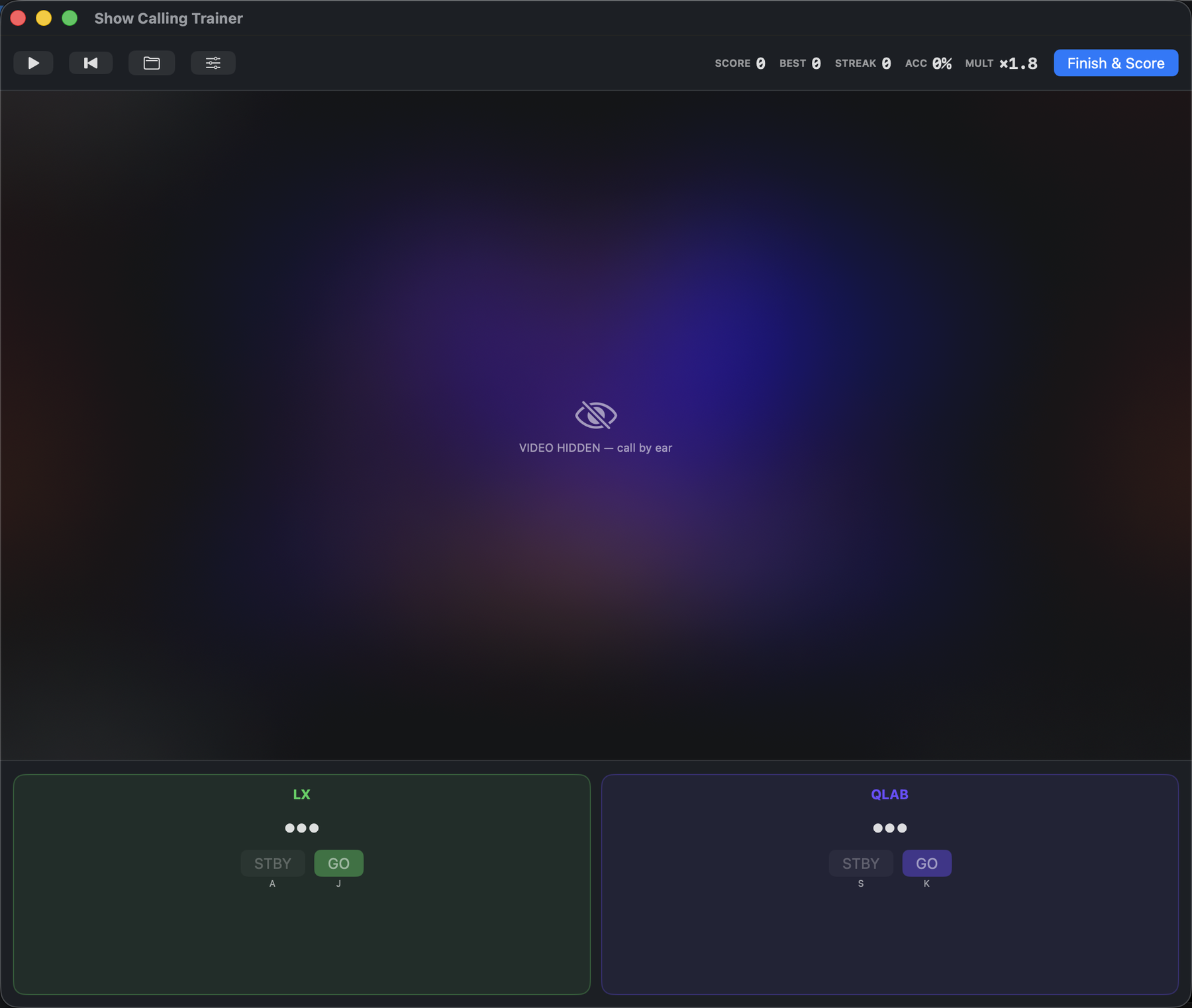
With Hide video and Hide hints on, the take is blanked ("call by ear") and the standby prompts vanish. The score multiplier climbs (×1.8 here) to reward the harder call.
Run range & audio
- Run range. Drill the whole show, or a window from one LX cue to another.
- Audio output. Route the program audio (usually track 1) to speakers or headphones so you can monitor while you call.
Report
Export a branded A4 PDF report. An exam-style pass/fail by accuracy, listing the failed cues with their off-by deltas. Reuses your session-report company name and logo.
Online trainer (showrevue.com/trainer)
The same drill runs in a browser at showrevue.com/trainer, so a DSM can practise on any
machine without the app installed. Drag a ShowRevue .mp4 recording onto the page and it reads
that take's own cues. Nothing is uploaded; the file stays on your device, and the scoring runs
locally. A ProRes .mov won't play in a browser, so drop its _cues.json sidecar in alongside, or
export an .mp4.
Enabling a recording for online training
The full online drill and its certificate are gated to Production-tier (or higher) recordings. A qualifying recording carries a server-signed entitlement token; the trainer verifies that token against the file's cues and, only then, runs the drill and issues certificates. A token-less file is blocked at a licence wall.
To mint the token, open the recording in ShowRevue and choose Playback ▸ Enable Online Training… while signed in to a Production+ account. This embeds the token in the recording (and its sidecar) and writes the show's acts into the file so the online trainer can offer act picks. The token binds to the cue payload, not the file bytes, so it works on old recordings and survives re-embedding.
Recover Timecode from Audio
For takes where LTC was recorded to a track but never decoded live (wrong routing, engine down), choose Playback ▸ Recover Timecode from Audio…. It reads the recording's audio offline, runs the LTC through the app's own decoder, and writes the recovered timecode segments plus a per-cue LTC stamp back into the recording.
Choosing what to rehearse
Before a frame plays, the trainer asks what to drill:
- Whole show, a single act (the stretch between nominated intervals), or a cue range.
- Call by ear hides the video so you call blind, or Watch the stage keeps it visible.
If a recording has no nominated intervals, no act list is offered. Nominate the intervals in ShowRevue and re-enable online training to get act picks in the browser.