Timecode
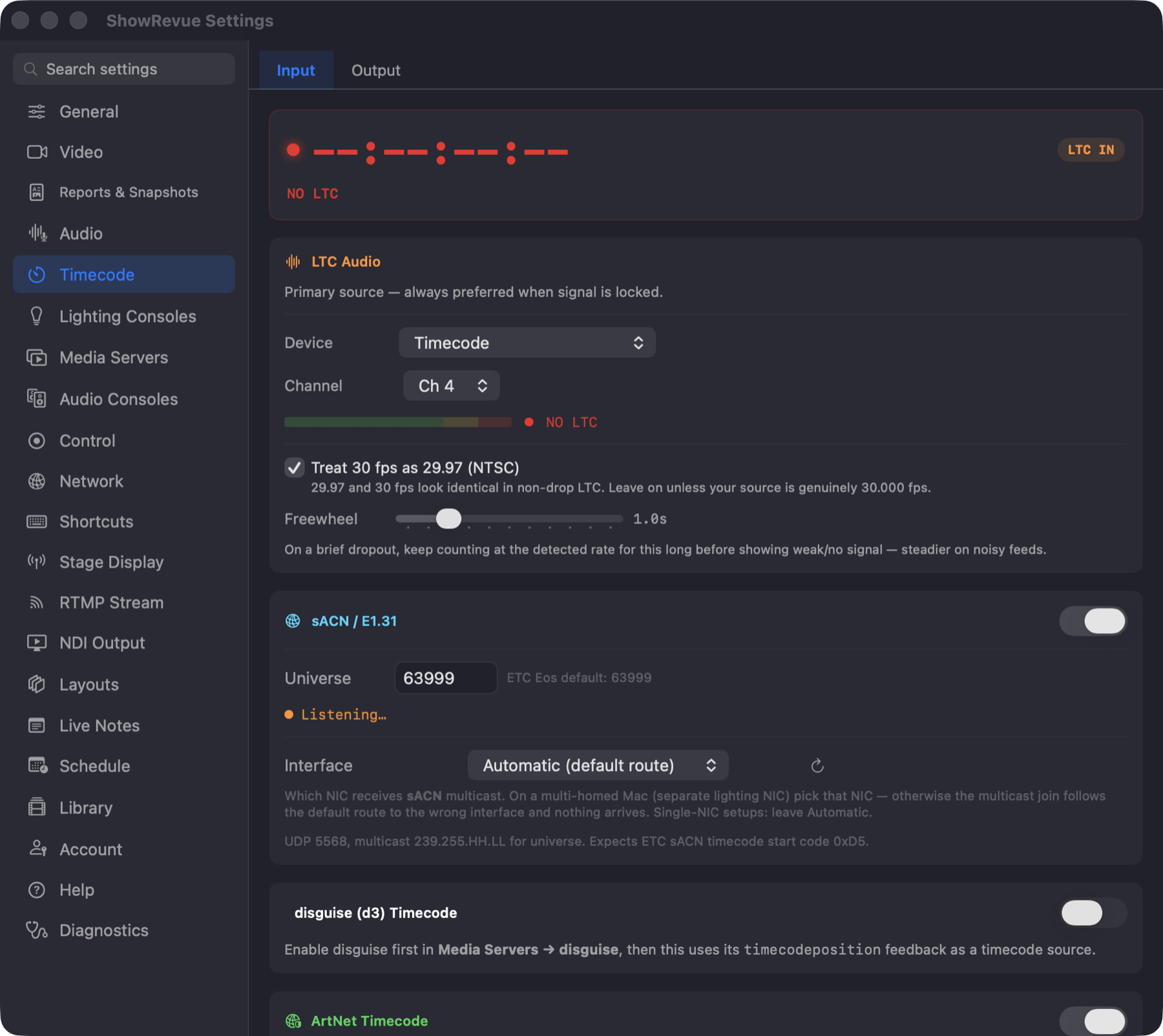
Preferences → Timecode, Input tab: LTC audio source, the network-interface picker for sACN, plus ArtNet, MTC and disguise. The Output tab holds Timecode Output.
All timecode settings live in Preferences → Timecode.
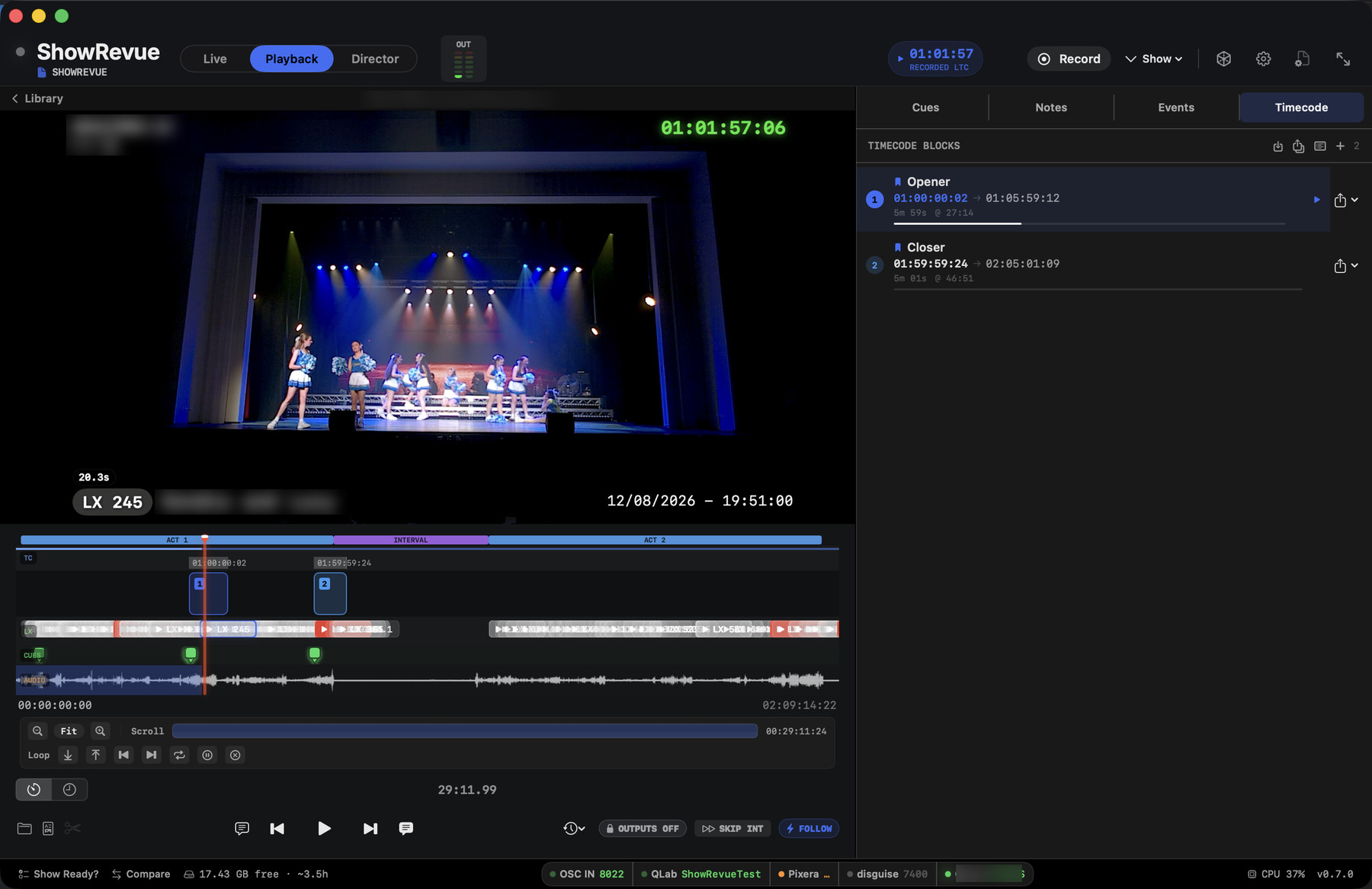
Captured timecode appears as blocks on the playback Timecode tab.
Playback: the LTC readout runs in sync and the timecode block fills as the playhead advances.
Timecode runs in both directions: ShowRevue reads timecode while you record, and can send the recording's timecode back out while you play it back (see Timecode Output below).
For input, ShowRevue reads timecode from five sources in this priority order:
- LTC (audio). Highest priority. Recorded with the video and decoded during playback.
- sACN E1.31. Multicast UDP timecode. Requires Capture or above.
- ArtNet Timecode. UDP port 6454, opcode 0x9700. Requires Capture or above.
- MTC (MIDI Timecode). Built from MIDI quarter-frame messages.
- disguise (d3). The server's
timecodepositionfeedback. Enable disguise under Preferences → Media Servers first. Last in the chain: LTC always wins.
LTC setup
- Connect the LTC source to an audio interface input.
- Open Preferences → Timecode.
- Under LTC Source, choose the audio device.
- Select the correct channel.
- Wait for the toolbar LTC chip to turn green.
ArtNet Timecode setup
ArtNet Timecode is a UDP-based protocol broadcast on port 6454. grandMA3 version 2.4 and later can output ArtNet Timecode natively.
- Open Preferences → Timecode.
- Enable ArtNet Timecode.
- The status shows Listening… when waiting, and Receiving (green) with the sender IP once packets arrive.
grandMA3 (v2.4+)
On the MA3 console:
- Go to Setup → Network → Timecode.
- Set Output Protocol to Art-Net Timecode.
- Ensure the console and Mac are on the same subnet (Art-Net uses broadcast).
- Start a timecode session. ShowRevue picks it up automatically.
Make sure the Mac's firewall allows incoming UDP on port 6454.
sACN Timecode setup
sACN (E1.31) timecode arrives as multicast UDP.
- Open Preferences → Timecode.
- Enable sACN and set the Universe to match the source.
- The status shows Receiving (green) once timecode packets arrive.
Network Interface (multi-homed Macs)
If the Mac has more than one network interface. For example a rig where the lighting network is on a separate adapter from the internet/Wi-Fi. Choose the right one under Preferences → Timecode → Network Interface.
sACN's multicast join would otherwise follow the system default route and land on the wrong interface, so no timecode arrives. Pick the interface on the lighting network. On a single-interface Mac, leave it on Automatic.
This only affects sACN (multicast). Art-Net is broadcast and arrives on any interface.
Timecode Output
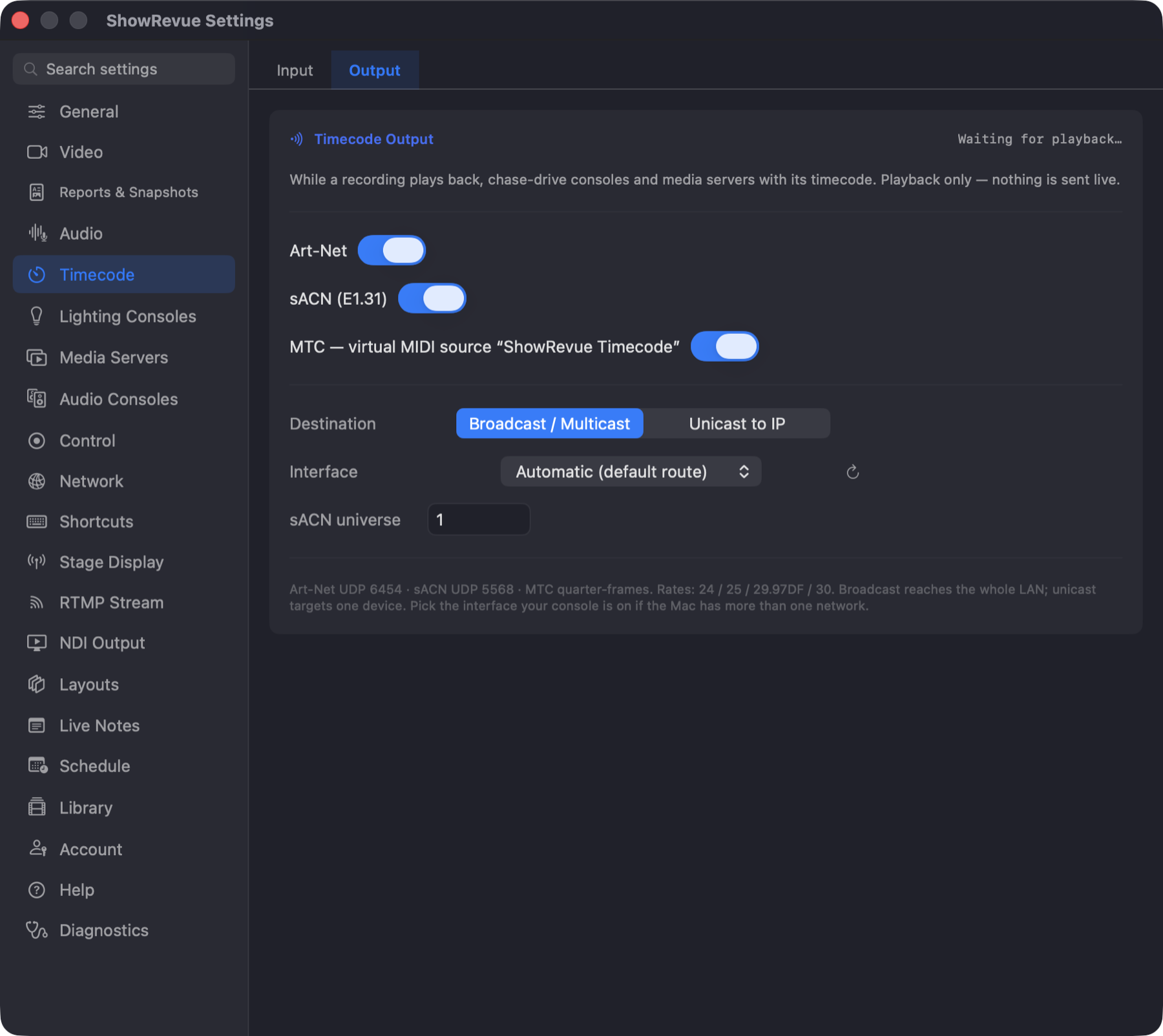
While a recording plays back, ShowRevue can send its timecode so a console or media server chases the rehearsal. Replay last night's run and the rig follows it. Playback only: nothing is ever sent while you're live or recording. Three protocols, each with its own toggle, usable in any combination: Art-Net (UDP 6454), sACN E1.31 (UDP 5568) and MTC (a virtual MIDI source named ShowRevue Timecode), with broadcast or unicast destinations and an interface picker for multi-homed rigs.
Enable it under Preferences → Timecode → Output. The full walkthrough is on the Timecode Output page.
Named timecode sections
Name spans of LTC so a stretch of timecode reads as "Act 1" or "Storm Sequence" instead of a
bare 01:04:30. Sections live on the playback viewer's Timecode panel:
- Use the
+button to add a section, or a block's "Name as Section…" item. - Double-click a block to rename it.
- Import a CSV of
start,end,namerows to name many spans at once.
A section is anchored by its LTC range, not by run-time, so it doesn't care which take it's in.
Sections save to the .srshow project (TimecodeSection) and to each recording's sidecar, so
the name re-attaches to every future performance of the show.
Wherever the live LTC sits inside a section, that section shows as a pill:
- on the player's bottom row,
- on the scrubber block tile,
- on the Director timebar, and
- on the companion app (pushed in the LAN + cloud state as
currentSection).
Exporting sections
Named sections can be batch exported as individual clips, each carrying its own timecode (programme audio left, LTC right) ready to import into a timecode-chasing tool such as Cuepoints. The same panel also writes a timecode report listing every section with its range, duration and the LX cues inside it.
Full walkthrough: Timecode Sections and Batch Export.
Show-level cuepoints
Timecoded cuepoints (the callable show beats you place in the Cuepoints lane on the player's Cues tab) are show-level: one set carried across every recording of the show, keyed to timecode. Placed inside a named section they chase the live LTC; outside one they pin to the recording's run-time. They feed NOW / NEXT and the standby → GO countdown in Director View.
Drop-frame timecode
ShowRevue counts 29.97 and 59.94 drop-frame timecode correctly end to end. Frame arithmetic skips the frame numbers that don't exist in drop-frame, so a freewheeled or reconstructed readout never drifts against the source (a plain 30 fps count would gain about 2 frames a minute).
Each recording stores the real timecode rate and drop-frame flag in its cue sidecar at record time, taken from the timecode that actually locked the take. Playback, the timecode readout, and Timecode Output all follow that stored rate. A 29.97DF recording plays back and chases as 29.97DF, whatever your preferences say today.
Drop-frame timecode displays with the SMPTE semicolon separator before the frames field. 01:00:00;12, so you can tell at a glance which counting mode a recording uses.